
Community
Sustainability
In his Catholic Social Teaching encyclical (n. 15), Laudato Si’: On Care for our Common Home, Pope Francis entreats ‘All of us’ to ‘cooperate as instruments of God for the care of creation, each according to his or her own culture, experience, involvements and talents’ (n. 14). He reminds us that the forgiving earth, our ‘sister’, ‘now cries out to us because of the harm we have inflicted on her by our irresponsible use and abuse of the goods with which God has endowed her.’ Laudato Si’ (n. 2).
(Education for Sustainability in the Archdiocese of Melbourne, 2015)
At Stella Maris we are taking steps towards the goal of embedding sustainability in everything we do and becoming a more sustainable school. Since 2012, we have been registered as a ResourceSmart School. Guided by our facilitators from CERES, we have participated in programs offered by various organisations that focus on environmental sustainability. We have established networks throughout the community and with other local schools. Some such programs include the Teaching and Learning for Sustainability Leadership Program (through the Port Phillip Eco-centre), the ‘I Sea: I Care’
Ambassador Program with the Dolphin Research Institute and our innovative whole school approach to waste management. These, along with participation in initiatives such as Active Travel days (Ride 2 School Day and Walktober) and maintaining our chicken community and Kitchen Garden have been incredibly successful over such a short timeframe. The main benefits seen from all such programs so far are the changes in attitude and enthusiasm from our children and staff. Everyone is on board!
In time, Stella Maris aims to achieve a 5 star sustainability rating as a ResourceSmart School. Our ultimate goal is to promote student ‘Voice and Choice’ and develop a culture of young leaders, actively engaged in making a difference with a ‘Think Global – Act Local’ attitude; Children with a growing awareness of local and worldly environmental issues, and skills to pass on to other children through a ‘Kids teaching Kids’ approach.
Current Projects:
- Composting waste
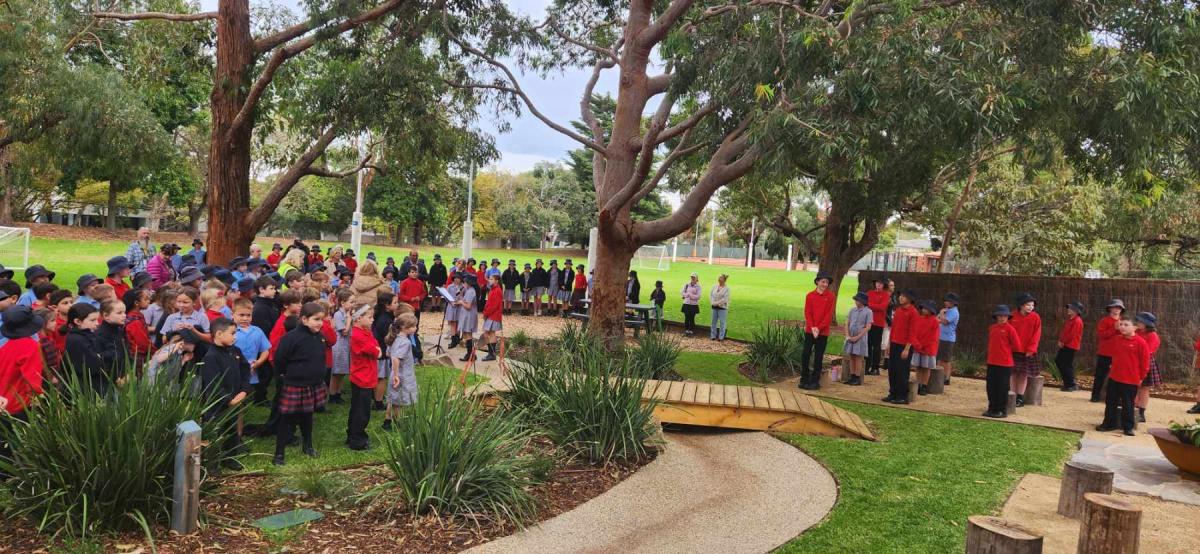
- The creations of our ‘Peace Garden’
- Teaching and Learning For Sustainability leadership program with the Port Philip Eco-centre (Year 6)
- ‘I Sea, I Care’ Ambassador Program with Dolphin Research Institute (DRI) (Year 6 School Captains)
Find out more about our partners:
CERES https://sustainability.ceres.org.au/
DRI https://www.dolphinresearch.org.au/
Port Phillip Eco Centre https://www.ecocentre.com/
Would you like to view a copy of the Education for Sustainability in the Archdiocese of Melbourne framework? Contact truyg@smbeaumaris.catholic.edu.au
Parents & Friends Association
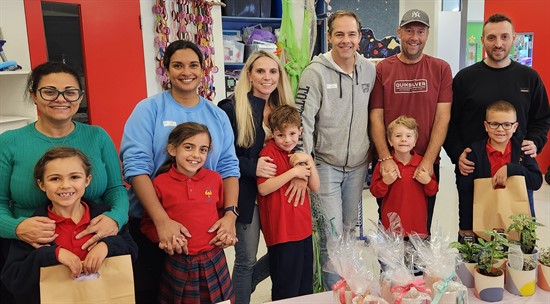
The Stella Maris School Parents and Friends Association is a friendly, social group of parents and guardians who meet regularly and help the school in a variety of ways.
The P & F aims to:
- arrange practical ways and means of contributing to the material and social development of the Stella Maris School Community.
- organise functions for the children only, children and parents, or for parents alone which will help all members of the school community to get to know one another well and thus facilitate the development of a genuine community. This shall be done through social, educational or community functions and it should aim to use the talents, skills and expertise of as many members of the school community as possible.
- be a fund-raising body which endeavours to raise monies to provide for those extra school facilities, furnishings and equipment, which cannot be supplied by normal school finances.
Some of the functions include:
- End of term Hot Dog Days
- Easter raffle and Easter bonnet parade
- Themed parent fundraising function each year
- Student disco
- Family movie night
- Mother’s Day and Father’s Day celebrations
- Christmas raffle
- Year level parent dinners
School Advisory Council
- Council structure
Members of the School Advisory Council
Serving on the School Advisory Council of a Catholic school is a form of Church lay ministry. It is a response to the call to support the local Catholic Parish and School communities in a particular way. It is also a means for members of our community to share their skills and talents for the common good. A well-functioning Council provides rich sources of wisdom and insight as well as a means of strengthening community links and potential for partnerships.
Stella Maris’ School Advisory Council is to be comprised of a minimum of six (6) Council members who value and share the educational mission and ethos of the Catholic Church comprising of at least:
(a) the parish priest for primary / the president of the ACA for secondary (ex officio)
(b) the school principal (ex officio)
(c) two (2) parents, guardians, carers of children attending the school
(d) one (1) parishioner
(e) another person from either category or co-opted to serve a particular need on the Council.
Membership under (c) and (d) are not mutually exclusive.
At the Principal’s discretion, members of the school staff may be invited from time to time to attend meetings depending on the content of the agenda.
A single parish representative may be sufficient for a Council fulfilling its function in dealing with education matters relating to the School.
2. Role of the School Advisory Council
From 1 January 2021, the Board of Melbourne Archdiocese Catholic Schools Ltd (MACS) has responsibility for the strategic direction and oversight of the operation and management of MACS Catholic Schools, including Stella Maris. Clear lines of authority, reporting and delegation have been established which delegate the day to day operational management of Stella Maris Catholic Primary School to the Principal.
In keeping with the objects of the MACS Constitution, which states “The good work of educating the young, undertaken in the light of the Gospel, is a co-responsible task led by every member of the Catholic school community”, the School Advisory Council provides a crucial point of connection between the wider School community and School leaders. While the School Advisory Council does not have a decision-making authority, it informs, advises and supports the Principal and School leadership.
Advisory in nature
The School Advisory Council provides a forum for discussion and discernment, where the parent/guardian voice and perspective are available to inform and support the decisions made by the Principal and Parish Priest for the good of School and Parish where the wellbeing and outcomes for students is paramount.
School Advisory Councils do not have a legal identity and do not become involved in the day-to-day management of the School.
It is important that School Advisory Council members understand that their role is to give consideration to, and advice on, important School matters in order to support the Principal in the context of the MACS governance arrangements. The School Advisory Council must act within the parameters of this Terms of Reference.
MACS provides support to the School Advisory Council, such as policy guidance and templates for the work of the Council, but is not responsible for the activities of the Council, utilising principles of subsidiarity and solidarity.
The following are some ways the School Advisory Council supports the School and the Principal:
- Promoting the school’s Catholic ethos and culture
- Articulating and enacting the School’s vision and mission
- Promoting faith formation and development
- Capital resource planning and maintenance
- Disseminating information about the School in accordance with these Terms of Reference
- Implementing School policies as required
- Supporting and communicating School and parish matters, including the School annual report
- Giving advice on issues such as enrolments, School improvement plans and enrolment trends
- Engaging in discussion about the annual School budget and other financial matters
- Giving advice about the school Master Plan
3. The role of individual Council members
Qualities and skills of a Council member
Each Catholic school is different, but all Schools share the mission of the Church. The Council should be composed of people who appreciate, value and share the educational mission and ethos of the Catholic Church. When seeking Council members it is important to reflect on the qualities and skills of benefit to the Council in carrying out its functions. Their capacity to contribute, their shared understanding and their positivity is essential.
The following is a list of some of the key qualities and skills for members of the School Advisory Council:
- commitment to the MACS Statement of Mission
- commitment to Catholic education in the Parish and School
- commitment to the vision and mission of the Parish and School
- an understanding of the role of Parish Priest, Principal and Council members
- willingness to ask questions and seek clarification
- ability to think strategically
- willingness to support the contributions of other Council members
- capacity to listen in an active and meaningful way
- willingness to work cooperatively with others
- commitment to maintaining confidentiality at all times.
Expectations of the Council member
Each Council member is required to commit to the following:
- understanding the Council’s role
- having a positive and constructive attitude
- elevating any appropriate issues for consideration by the Council
- preparing for Council meetings
- attending each Council meeting, unless there are extenuating circumstances
- bringing expertise and views to discussions on behalf of the whole community
- participating actively and responsibly
- participating in Council work
- participating in Council formation activities
- attendance at the MACS Annual General Meeting, if possible
- abiding by the applicable MACS School Governance Policies, including MACS Statement of Mission, the Code of Conduct and Conflicts of Interest Policy.
- Key roles
There are four key roles on a School Advisory Council. The Chair, the Principal, the Parish Priest and the Secretary each have a significant role on the Council and each of these roles carries specific responsibilities.
The Principal
Key responsibilities of the principal’s role include development of the faith community, particular focus on the safety and wellbeing of students, formulation of a vision for the whole school, attention to contemporary teaching and learning in order to engage all students, and stewardship of the people and resources with particular outreach to the parent community.
The principal works in collaboration with the Church authority, staff and members of the school community to achieve the mission of the school.
As such the Principal’s role on the Council as an ex officio member is to:
- play a key role in developing the overall goals and priorities of the Council
- play a key role in developing the agenda for meetings and the preparation of papers before meetings
- ensure follow-up of actions arising from Council meetings
- act as the chief education advisor to the Council
- make arrangements to maintain an archive of relevant Council documentation in accordance with this Terms of Reference, including minutes from previous meetings
- make arrangements to distribute the papers before meetings, after preparation of the papers by the Secretary
- make arrangements to distribute draft minutes to the Council members, after preparation by the Secretary
- ensure that Council members are kept informed between meetings
- make arrangements to maintain a register and record of Council, committee and working groups and all applicable documentation and records, including minutes, agendas and correspondence.
Appointment
The Principal is an ex offico member of the Council while in his or her role. The Principal has full voting rights and is counted in the usual way for quorum purposes.
The Parish Priest / President of ACA
The Parish Priest/Canonical Administrator’s role on the Council is to:
- be the key evangeliser and educator in faith within the Parish and thus the custodian of mission of Parish and School
- support the Principal and Council in the development and implementation of the sacramental program to ensure the School is faithful to its distinctive Catholic identity and spirituality.
- provide strong pastoral support and effective Catholic leadership of the Parishes which includes the School and College communities.
- be engaged with, and bring to the Council’s attention, those aspects of the School’s operations that have the potential to harm the Parish’s good name
- represent the Parish or College as the beneficial owner of the land occupied by the School
- be involved in planning any transaction that will change the nature of the School property or affect the use of any other areas of the property.
- The parish priest is an ex officio member of the school advisory council for parish primary schools in his parish, and ensures that the school advisory council supports the principal and the mission of the parish. Likewise a representative of the Canonical Administrator for Regional Colleges is an ex officio member of the school advisory council ensuring that the council supports the principal and the mission of the college
Appointment
As an ex officio member of the Council by virtue of his office. The Parish Priest/Canonical Administrator has full voting rights and is counted in the usual way for quorum purposes.
4. Committees and working parties
To share and support the work of the Council, the Council may consider establishing a standing committee.
From time to time the Council may also wish to establish a committee or working party for a specific purpose or to undertake a particular task.
The Council may appoint additional members of a Council committee or working group to assist with deliberations in the manner determined by the Council in each instance.
Council committees and working groups may be focused on a specific area such as:
- finance
- policy
- capital improvements
- reputation management
- parent/guardian/carer engagement
- community development
- grants
Each committee or working party should be chaired by a Council member who is responsible for reporting to the Council on the activities of the committee/working party.
Council committees/working parties are directly responsible to the Council.
Each committee/working party of the Council should have clearly articulated expectations or terms of reference stating:
- the name of the committee/working party
- the name of the chair
- the purpose and tasks to be undertaken
- the names of the members
- quorum, meeting and reporting requirements
- the date for reporting back to the Council e.g. actions since last report, what’s happening now, future plans, items for council discussion
- duration of the committee/working party.
It is important that any Council committee or working party understands that it may not speak publicly for the Council, unless it has delegated authority to do so.
The terms of reference of each committee or working party of the Council should be approved by the Principal and appropriate records maintained by or on behalf of the Principal.
A summary of the activities of each committee or working party should be included in the Council’s annual report to acknowledge the specific work undertaken by the committee or working party during the year.
School Uniform
Our school has a very smart uniform, which visitors to the school often comment on. It is compulsory for children to wear the correct uniform. Not only does this automatically give each child equal status and prevent competition and discrimination, it also is a sign of respect and order.
School uniforms are checked regularly, particularly sock colours and hats. Parents whose children are wearing the incorrect uniform are contacted by staff. If children are unable to wear the correct uniform for a short time, a note to the classroom teacher is expected. The wearing or bucket style school hats became compulsory for all students, as we phased out the legionnaire and broad rimmed styles. The newsletter will contain a list of afternoons on which the Uniform Shop is open. The Uniform Shop is located in the Multi Purpose Room.
Please open the files below to read the School Uniform Policy and obtain the Uniform Order form
Lunch Orders
Classroom Cuisine is an Online alternative to the traditional lunch orders we have had at Stella Maris in the past, offering a convenient, user friendly service; creating, preparing, packing and delivering high quality school lunches at the most affordable price. They provide nutritious, well balanced, tasty food for our children’s lunches.
Their Mission is to delight both their ‘Diners’ with the quality of their lunches as well as the schools that offer their service by ensuring it’s hassle free for them. They have been operating since 2009 and now service more than 85 Schools.
Their products may contain egg, milk, oats, rye, soy and wheat products. They take great care in the preparation of products however due to the nature of processing, trace amounts of sesame and nuts may be present in some products. Again, your child’s meal should never be shared with another child.
The kitchen staff are supervised by accredited “Food Safety Supervisors” and adhere to all rules and regulations governing safe food preparation under the guidelines of Boroondara City Council Environmental Health Services, the Victorian Food Act 1984 (State) and FSANZ Food Standards Code (Federal).
Classroom cuisine post their Menu at the start of Term for the Whole Term and you are able to ORDER IN ADVANCE and CANCEL AN ORDER if for some reason you don’t require it (e.g. child illness/school activity). THEY DO NOT ACCEPT LATE ORDERS! You will be unable to access the Menu to place orders for the current day after 8.30 am. The suppliers log in to their system at and supply only the items of food ordered for that day.
Lunch orders are available each Friday. Click on the link below to place an order.
https://classroomcuisine.com.au
Parish
Our Parish Priests
Parish Priest:
Fr Justin Ford
Assistant Parish Priest:
Fr Joseph Nguyen
Website:sspjv.org
Email: mentoneparkdaleeast@cam.org.au
To speak with the parish priest, please contact St Patrick’s Mentone on 9583 2103
Office Hours:
Monday to Thursday 9.00am to 5.00pm
Outside School Hours Care
We are happy to partner with Team Kida to provide our outside school hours care program.
To find out more about the program at our school, including hours of operation, fees and how to register please visit their website. (see below)
Contact Details
Team Kids Head Office:
1300 035 000
Team Kids Website: teamkids.com.au
Hours of Operation
Before School Care (Beaumaris Primary School) 7:00am – 8:45am
After School Care (Beaumaris Primary School) 3:15 pm – 6:00 pm
Bookings
When completing your enrollment details online, you will indicate what type of booking you need to make. We have two types of bookings:
Permanent Booking: These bookings are made as 1 session or more per week for an entire term. Permanent bookings will automatically carry over until notification of a change is received by our Customer Service Team.
Casual Booking: These bookings can be made right up to the session commencement time. The Casual Booking fee attracts an additional cost on top of the Permanent Fee, as we will need to arrange for additional food, resources and potentially staff.